
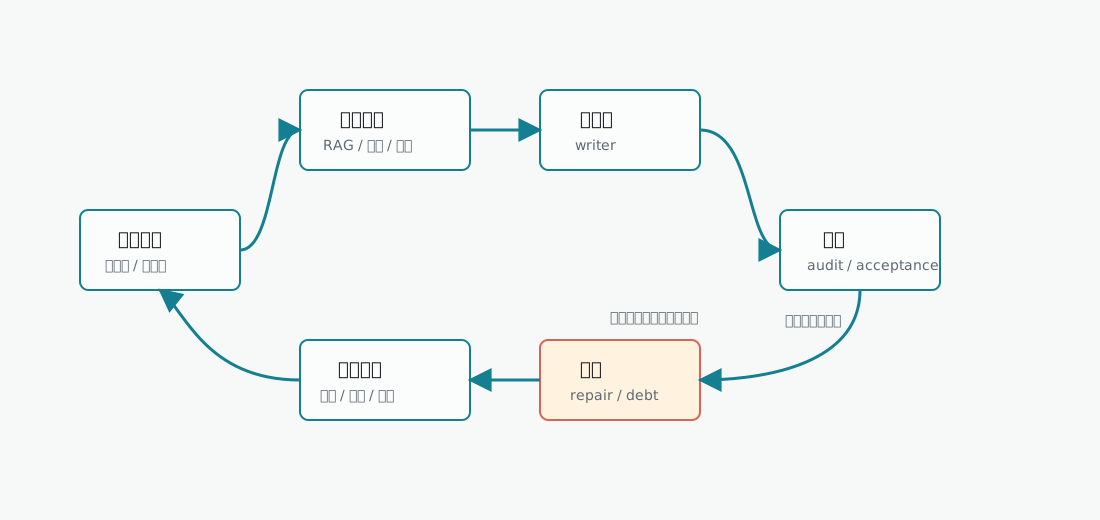
Chapter execution loop
What Is a Chapter Brief
A chapter brief is the contract for body-text generation, not a simple title. It comes from Auto Director’s Chapter Detailing (章节细化) phase, and usually contains:
If the brief is missing or too vague, body-text generation quality will usually be unstable. In this case, prioritize returning to chapter detailing, rather than temporarily adding a sentence of “write better” in the body-text input box.
Execution Entry Points
Chapter execution usually enters from two entry points:
Before execution, a chapter task must exist. The task comes from Chapter Detailing (章节细化), containing chapter goals, carry-over relationships, scene cards, characters, conflicts, and taboos.
Context Assembly: What Materials Are Prepared for the Model
Before body-text generation, the system aggregates multiple materials into a context package. This package determines what the model knows and does not know, directly affecting body-text quality.1
This book's facts and planning
Book contract, macro story, volume window, fact ledger, foreshadowing ledger. These are the highest priority and cannot be overridden by external materials.
2
Character and world states
Current character goals, locations, relationships, abilities, available resources; this chapter’s related world rules, locations, and faction boundaries.
3
Style assets and Anti-AI Rules
Bound style profile, style rules, anti-template expression constraints. Control how body text is written and what not to write.
4
RAG recall materials
Construct queries based on the chapter task, and recall the most relevant material fragments from the knowledge base.
Why Chapters Cannot Rely Only on Prompts
Long-form novel subsequent chapters depend on already-occurred facts, character resources, reader promises, and world constraints. The chapter execution chain assembles these into a context package, avoiding reliance on temporary input for every chapter. Without this package, the model easily forgets previously planted foreshadowing, abilities the character just obtained, or world rule limitations.Body-Text Generation and Audit
After the context package is prepared, the system enters body-text generation. After generation, it immediately enters audit, judging whether body text satisfies the chapter task.Quality Judgment Layers
Audit results are divided into multiple layers, with different impacts on the global chain:Local quality debt does not equal global failure. As long as the chapter has usable body text, and the system does not explicitly require replanning, prioritize saving body text, recording debt, and allowing subsequent chapters to continue. This avoids a book repeatedly getting stuck because of a single chapter’s minor issue.
Repair and Quality Debt
Issues found by audit enter the repair chain. Repair is not an infinite loop; the current chain limits retry counts and records quality debt.What Is Quality Debt
Quality debt indicates the chapter has visible issues, but does not necessarily need to stop the whole book. Typical examples:- Local pacing is not strong enough
- Individual foreshadowing hints are insufficient
- A certain passage’s character tone needs later revision
- The repair tool cannot stably anchor a certain paragraph
State Backfill: Letting the Next Chapter Base on Latest Facts
After chapter execution completes, the system backfills new states into novel assets. This is the core mechanism that lets long-form writing continue.How to Judge When Backfill Fails
Chapter body-text generation and state backfill are two different problems. When body text is already usable, prioritize fixing the backfill chain. Directly rewriting may create new factual forks.
How RAG and Knowledge Base Participate in Chapter Execution
Chapter execution recalls the knowledge base, book breakdown, style, and this book’s assets during context assembly. RAG materials are only part of the context and should not override the chapter brief.Material Source Layers
How Chapter RAG Queries Are Constructed
The system does not directly search materials using chapter titles. It assembles queries based on the chapter task, containing novel title, chapter title, chapter goal, chapter expectation, this chapter’s must-advance content, target conflict, appearing characters, and structured outline. The closer the query is to this chapter’s goal, the easier the recall is to hit truly useful materials.Retrieval Methods
Priority When Conflicts Occur
RAG’s goal is to let the system know more, not to give external materials the highest decision-making power.
How Batch Execution Advances
Chapter batches usually do not write only one chapter at a time. Batch execution saves state between each chapter and decides whether to continue to the next chapter.
If auto-approval is not authorized, the batch may pause at certain nodes waiting for confirmation. This is to let the user see risks, rather than the backend “not responding.”
This Book’s Issue Handling Rules
Each book can inherit global rules, or choose a set of issue handling plans in this book:
Item-by-item rules can also choose auto-retry, remind then continue, pause processing, or end task. Save failure, data integrity risk, protected content, and other runtime safety issues will still prioritize protecting the work.
Failure Modes and Recovery
Manual Intervention Entry Points
Do not throw all problems at body-text rewriting. Body-text rewriting is suitable when body text is unavailable; task, asset, recall, and sync problems should return to the corresponding entry.
FAQ
Why can't a chapter just be given a title and let the model write?
Why can't a chapter just be given a title and let the model write?
Long-form novel subsequent chapters depend on already-occurred facts, character resources, reader promises, and world constraints. Without a brief and context package, the model easily forgets previous settings, violates character states, or misses foreshadowing. The chapter brief provides clear advancement goals, scene cards, and constraint boundaries, and is the contract for body-text quality.
Will quality debt affect subsequent chapters?
Will quality debt affect subsequent chapters?
It will not directly block. Quality debt is recorded and then continues to advance subsequent chapters, but debt content will be referenced in subsequent audits and planning. If the debt involves structural issues, it may trigger a replanning suggestion later.
Will RAG recalled materials override this book's already-written content?
Will RAG recalled materials override this book's already-written content?
No. This book’s facts and the fact ledger are the highest priority. RAG materials are used to supplement settings and references, and cannot overturn content already written into the novel state. If recalled materials conflict with this book’s facts, the system will prioritize following this book’s facts.
When state sync fails, will the next chapter write based on old states?
When state sync fails, will the next chapter write based on old states?
If state is not backfilled, the next chapter’s context may lack this chapter’s latest facts. In this case, first fix the sync, then execute the next chapter, to avoid factual forks. When body text is already usable, there is no need to rewrite; only supplement the sync.
Is there a limit on single-chapter repair retries?
Is there a limit on single-chapter repair retries?
Yes, there is a limit. The current chain limits repair retry counts to avoid infinite loops. If low-risk repair cannot resolve, it records quality debt and continues; if it involves structural issues, it enters a checkpoint waiting for user confirmation.
Can I manually modify body text and then let the system continue?
Can I manually modify body text and then let the system continue?
Yes. You can manually modify body text on the chapter page. Modified content will become the fact source for subsequent chapters, but the system will not automatically reverse-sync to character states or the foreshadowing ledger. If the modification involves important fact changes, it is recommended to simultaneously check related assets.
Knowledge Base & RAG
Learn how materials are ingested, recalled, and participate in context assembly
Creative Production Pipeline
The complete three-layer chain from Idea Layer to Chapter Execution Layer
Auto Director
Learn about director phases, run modes, and checkpoint mechanisms